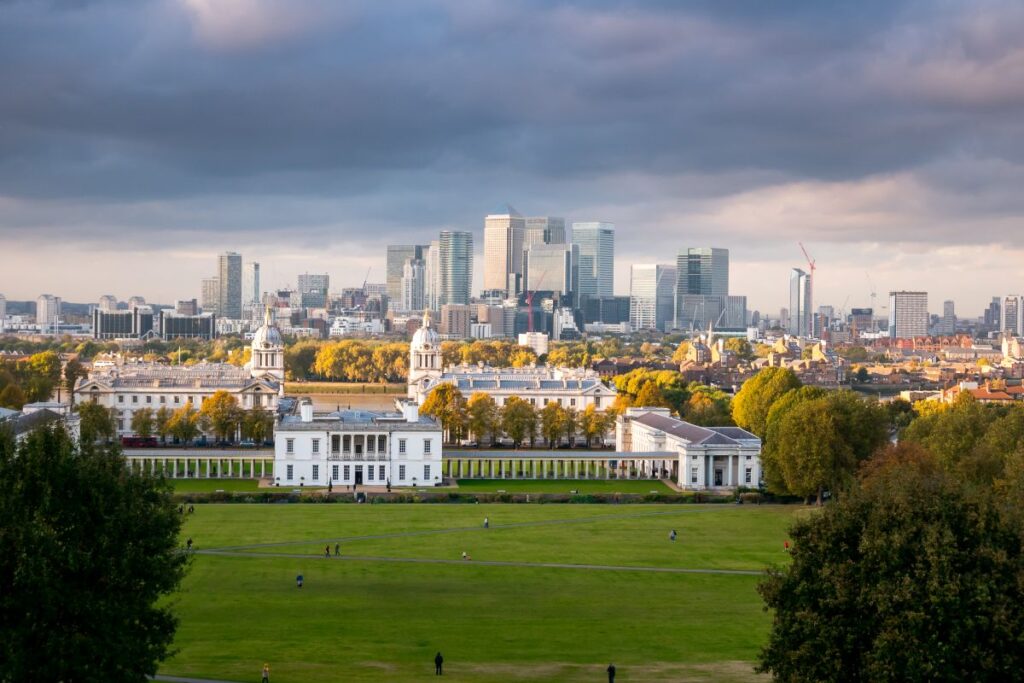
Eight minutes by train from London Bridge, and you arrive somewhere that feels entirely different from the city you just left. Greenwich is one of those places that carries its history visibly - in the stone of the buildings, in the ships in dry dock, in the line scratched into the courtyard of the observatory that divides the eastern and western hemispheres. It was a royal palace before it was anything else, birthplace of Henry VIII and Elizabeth I, seat of Tudor power on the Thames. Karlo comes from Croatia, but the last seven years he has spent in the United Kingdom, exploring the country and its rich history. He considers himself a writer, and he has three books published to his name. His tour is more about the early 19th century, when Greenwich became something arguably more significant - a centre of maritime power, scientific authority and the global trade networks that shaped the modern world as we still know it.
The Greenwich Foot Tunnel is where this particular tour begins, emerging from beneath the Thames on the south bank to arrive in Greenwich the way sailors once arrived: from the river. The tunnel itself, opened in 1902, is a pedestrian crossing 50 metres below the water, tiled in white and lit by a single overhead strip. It’s a strange, quiet, slightly surreal way to enter one of London’s most historic districts, and it sets the right mood.
The Cutty Sark is the first thing you see when you come up from the tunnel, sitting in dry dock in a glass enclosure that raises the ship above the ground so you can walk underneath its copper-sheathed hull. Launched in 1869 to carry tea from China, it was in the Australian wool trade that it made its real name - regularly arriving in Sydney weeks ahead of its rivals, its speed the product of a hull design that remains elegant a century and a half later. It is the last surviving tea clipper in the world, and standing beneath it you get a sense of both the ambition and the physical reality of what 19th-century ocean trade meant.
More than just the place where the world was measured and mapped
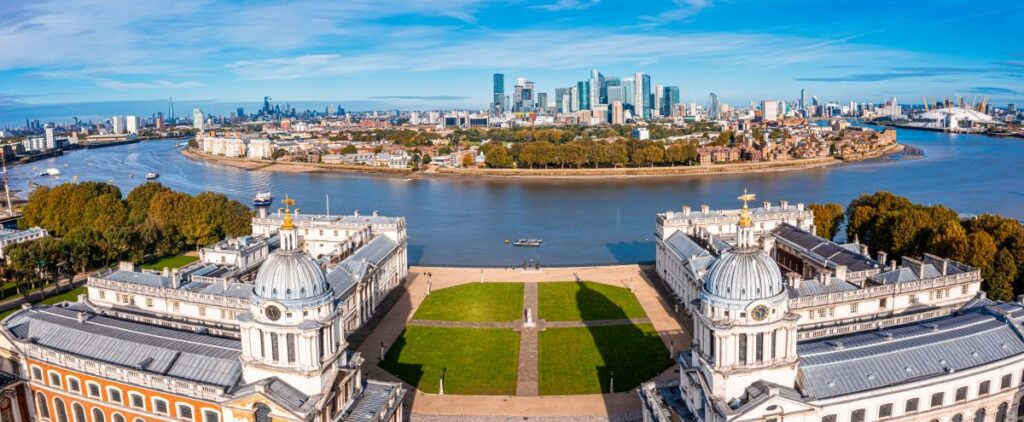
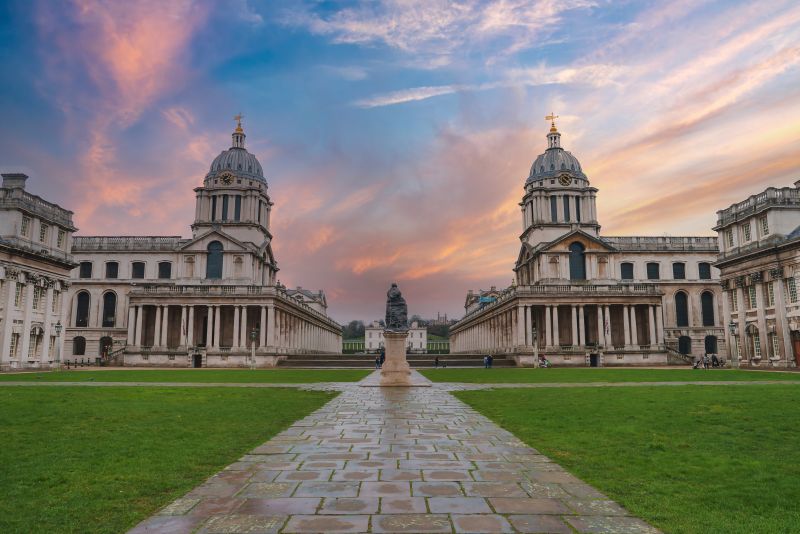
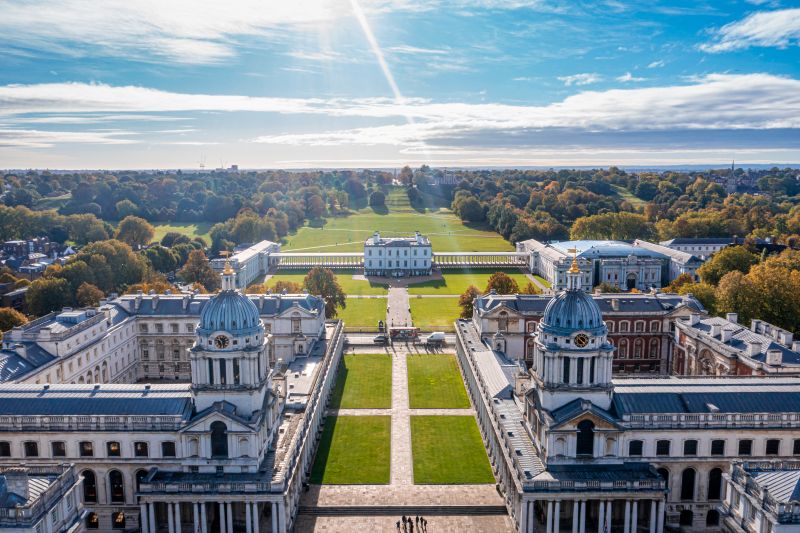
Greenwich Market is a few steps away - a covered market selling food, crafts and antiques, one of the few in London that still has genuine character. Good for breakfast or a browse before the more serious part of the tour begins. The Royal Naval College Grand Square is where things shift register entirely. Designed by Sir Christopher Wren in 1694 - he gave his services for free - the Old Royal Naval College is one of the greatest architectural ensembles in Britain, twin baroque domes flanking an open axis that frames the Queen’s House in the distance. It was built as a hospital for retired sailors, a charitable institution on a grand scale, intended also to announce Britain’s growing maritime power to anyone arriving on the river. Today it houses the University of Greenwich and the Trinity Laban Conservatoire of Music and Dance; on any given afternoon you can hear students practising in the historic colonnades.
The Old Brewery, tucked within the college grounds, is the pause point - a working craft brewery and restaurant in a Georgian building, serving seasonal British food and beer brewed on site, including Greenwich Gin distilled in the courtyard. Worth building in some time here.
The Painted Hall is the reason to book tickets. Called Britain’s Sistine Chapel by more than one writer, it is a Baroque masterpiece on a scale that takes a moment to absorb: 40,000 square feet of painted walls and ceilings, the work of Sir James Thornhill completed over 19 years between 1707 and 1726, depicting William III and Mary II in triumph and marking the moment Britain became the dominant European power. In 1806, the body of Lord Nelson lay in state here before being taken to St Paul’s for burial - more than 30,000 people came to pay their respects. The Colonnades that run alongside the college are the architectural detail that rewards slower looking: classical columns framing river views, the sound of music students occasionally drifting through the arches. The National Maritime Museum is free and one of the finest museums in London. Its collection runs from Tudor navigation instruments to the uniform Nelson was wearing at Trafalgar - the coat still carries the bullet hole. The building’s central glass-roofed courtyard is one of the best interior spaces in the city. The Queen’s House next door is a Palladian villa designed by Inigo Jones in the 1630s, one of the most important buildings in British architectural history and the structure that determined how everything around it would eventually look. Queen Mary II specifically ordered that the new Royal Naval College not block the view from the Queen’s House to the river, which is why the twin domed buildings are arranged as they are today.
The Royal Observatory sits at the top of Greenwich Park, a hill walk of about ten minutes from the museum. Designed, again, by Christopher Wren, it was built in 1675 by Charles II to solve the problem of maritime navigation - specifically, how to calculate longitude at sea, the question that determined whether ships lived or died. The Meridian Line is marked in the courtyard, the line from which all longitude is measured and from which Greenwich Mean Time takes its name. Standing with one foot on either side of it is a minor ritual that everyone does and no one feels embarrassed about. At night, a green laser cuts along the line across the London sky. The view from the hill - over the Royal Naval College, down the river to Canary Wharf and the City, with St Paul’s and the Shard visible on a clear day - is one of the best in London. Greenwich was featured on Tourizzy by a Croatan writer from Greenwich, Karlo.