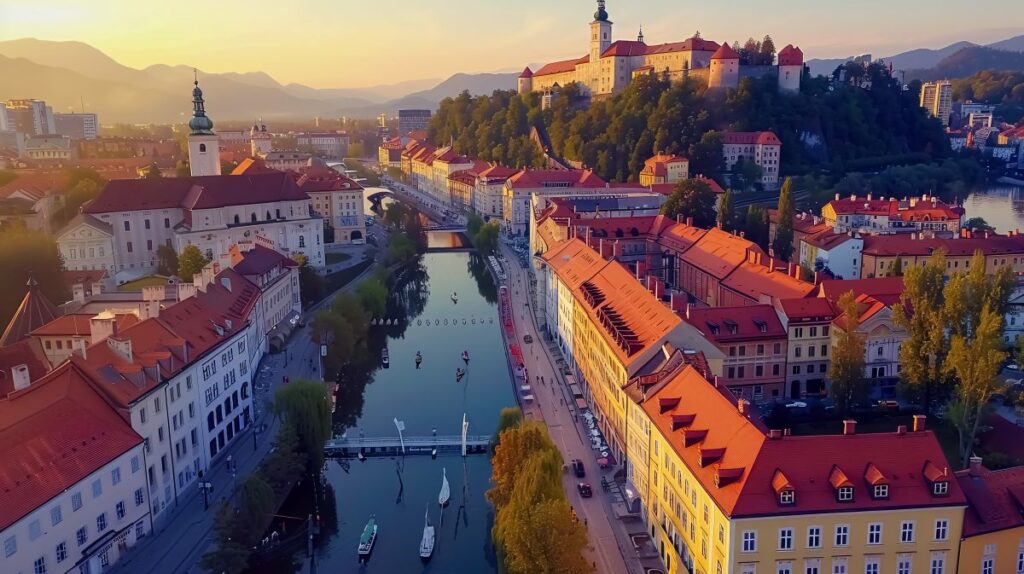
Ljubljana is one of those cities that takes about twenty minutes to fall for and considerably longer to leave. It’s small enough to walk across in an afternoon, architecturally coherent enough to feel like it was designed by one person - in large part because it was - and relaxed enough that you spend most of your time there wondering why the rest of Europe isn’t more like this. Mateja, a Ljubljana-based heritage tourism specialist who has spent years bringing the city’s stories to life, designed a 2.5 km self-guided walk that covers both the famous and the easily missed, weaving through bridges, markets, baroque squares and narrow lanes in a loop that ends exactly where it begins.
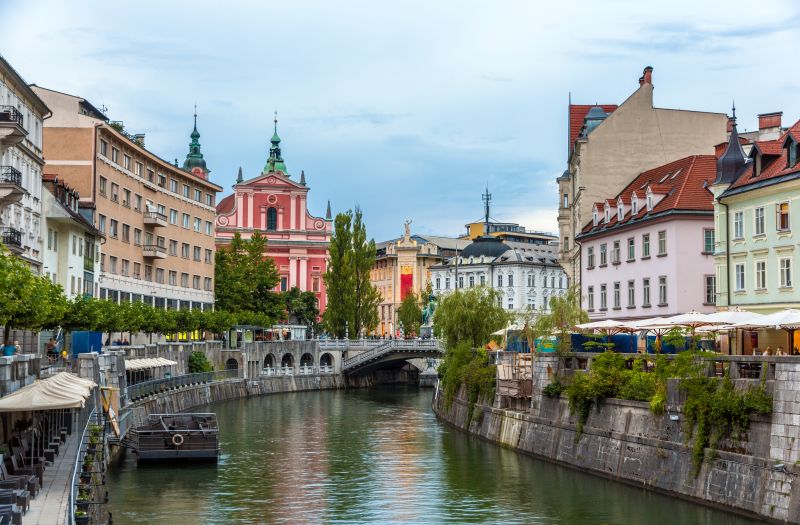
Prešeren Square is the start and the heartbeat - the central meeting place of Ljubljana, framed by the rosy Franciscan Church on one side and the Triple Bridge on the other. The statue of France Prešeren, Slovenia’s greatest poet, stands at its centre, gaze aimed across the square toward a relief portrait of his muse Julija Primic, set into the corner of a building. She was the daughter of a wealthy merchant who never returned his love, and he wrote about her for the rest of his life. The city commemorated both of them in stone and set them facing each other across a pedestrian square for eternity. It’s one of the more quietly affecting pieces of urban symbolism in Europe.
The Triple Bridge is Jože Plečnik’s most iconic contribution to Ljubljana, three parallel bridges spanning the Ljubljanica built between 1842 and 1932, connecting the old town to the modern city in a way that manages to be both functional and genuinely beautiful. Plečnik reshaped much of Ljubljana in the first half of the 20th century - the covered market arcades running along the left bank are UNESCO-listed, classical in form but entirely his own in character, and the city is full of his lamp posts, fountains, staircases and small interventions that you start to notice once you know to look for them.
Bridges, Dragons and the Baroque
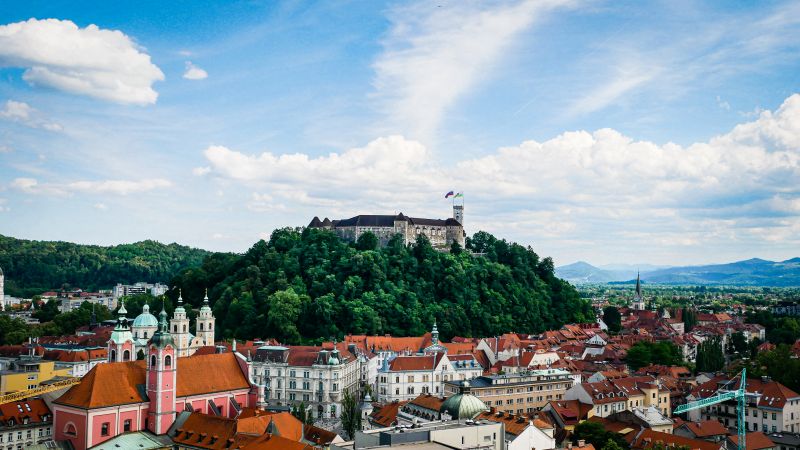
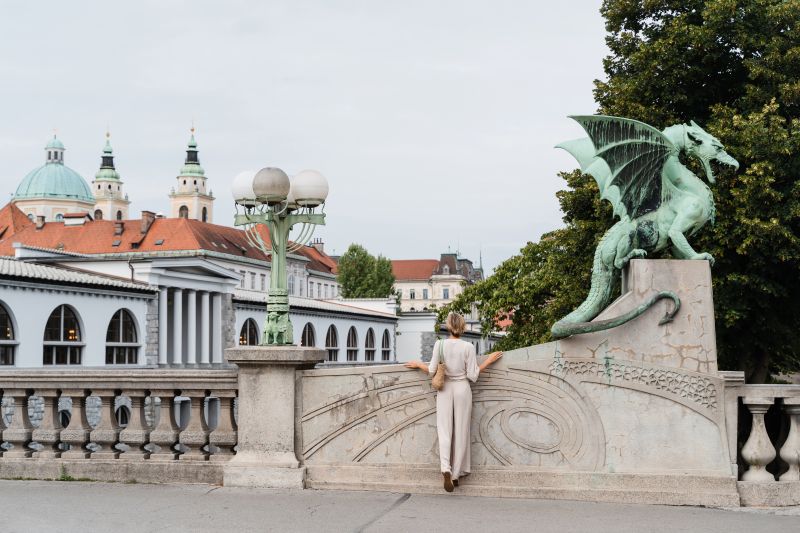
The Butchers’ Bridge is the playful one - a modern footbridge with glass panels and quirky bronze sculptures, covered in love locks left by couples from around the world, directly adjacent to a permanent installation of small figurines clinging to the railings and each other. It is the exact opposite of grand and entirely charming. The Dragon Bridge is the other kind entirely: four large green copper dragons guarding an early 20th-century bridge that has become the symbol of the city. The legend says the dragons wag their tails when a virgin crosses, which the city has been exploiting for tourism purposes for over a hundred years without anyone minding very much. From here the castle funicular is visible, its glass cabin climbing the wooded hill above the old town; the castle at the top offers the best panoramic view of Ljubljana and the Alps beyond.
The Farmers’ Market along the Ljubljanica has been a meeting point for locals for centuries and still functions as a genuine market rather than a tourist attraction - seasonal produce, flowers, local cheese, honey, the rhythm of people who do their shopping here every week. The Cathedral of St. Nicholas, just behind the market, has baroque frescoes, marble altars, and a set of bronze doors known as the Slovenian Door, cast in 2006 and depicting 1,250 years of Christianity in Slovenia across a surface of intricately worked scenes. Most people spend less than ten minutes inside; most people should spend longer.
Town Square and the Robba Fountain mark the civic heart of the old town, the fountain - inspired by the great Baroque fountains of Rome - representing the three rivers of Carniola, the historic Slovenian region. Ključavničarska ulica, a narrow lane off the square, is Mateja’s kind of discovery: a quiet, slightly crooked street with boutique shops, café tables and bursts of street art that represents the more intimate side of the old town, away from the main foot traffic. The Fisherman Footbridge gives you a different angle on the city’s coloured facades and rooftops, and Congress Square opens up on the far side of the river as one of Ljubljana’s grandest spaces - the University, the Philharmonic Hall, and the Slovenian Parliament all within view of each other, the square itself serving as a concert venue, festival site and general gathering place throughout the year. The Emonec sculpture on Slovenska cesta is a playful nod to the Roman settlement of Emona that preceded Ljubljana, the city’s oldest layer peeping through the modern main street.
The walk comes full circle at Prešeren Square, and Mateja’s suggestion for the final moment is to find the relief of Julija Primic on the corner building and look back at the poet’s statue across the square. The unrequited love that produced some of the finest poetry in the Slovenian language, turned into a permanent installation in the city’s most central space. Ljubljana is full of stories like this. You just need someone who knows where to look. Ljubljana was featured on Tourizzy by Mateja, a local heritage tourism specialist and guide based in Ljubljana.